← Home · Underground Excavations

Soft Ground Tunnel Geotechnical Analysis in Fontana

Together, we solve the challenges of tomorrow.

LEARN MORE →

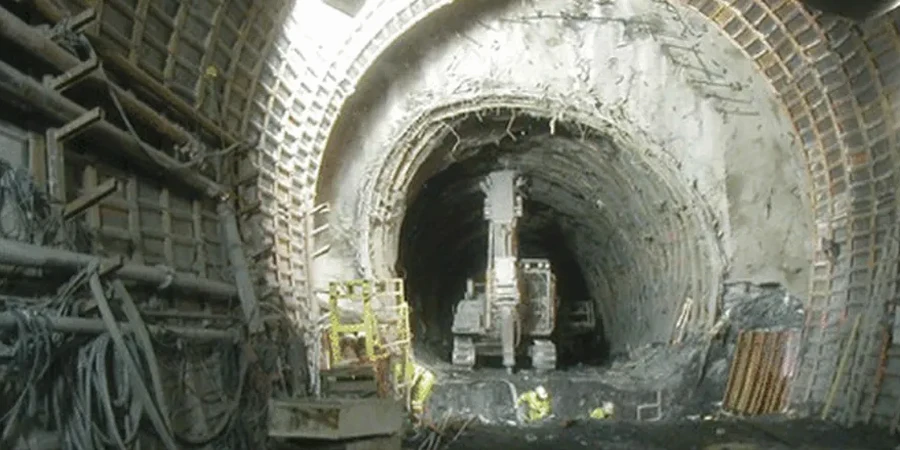
The TBM cutterhead torque can spike 40% above predicted values when you hit a discontinuous hardpan lens in Fontana's alluvial fan deposits. Our geotechnical analysis for soft soil tunnels starts with a full-face characterization program designed specifically for the transition zones between the San Gabriel Mountains' outwash and the Rialto-Colton basin silts. We run ASTM D2487 logging on continuous cores, triaxial consolidated-undrained tests at in-situ confining pressures, and point load indexing every 0.6 meters through the cobble-bearing strata. The lab program integrates grain-size distribution curves with Atterberg limits to bracket the tunnel face behavior from firm to flowing ground conditions. For sections where the groundwater table sits within one tunnel diameter of the crown, we add deep-excavations support pressure analysis calibrated to measured pore pressures at depth.

Fontana's alluvial basin deposits demand a tunnel face pressure window narrower than 15 kPa to balance blowout risk against excessive settlement.
How we work

ASCE 7-22 Chapter 22 and IBC Section 1810 govern the seismic design basis for underground structures in Fontana's mapped alluvial soils. The city's Site Class D profile — with shear wave velocities averaging 260 m/s in the upper 30 meters — means a tunnel lining designed for static overburden alone will fail the combined racking and ovaling deformation check under the 2,475-year return period event. Our geotechnical analysis for soft soil tunnels applies the Wang (1993) free-field deformation method with site-specific liquefaction triggering assessment per NCEER/Youd-Idriss procedures. We run undrained cyclic triaxial on thin-walled Shelby tube samples extracted from the tunnel horizon. The resulting modulus degradation curves feed directly into the moment-thrust interaction diagrams for the segmental lining. For mixed-face conditions where the lower third of the tunnel sits in cemented older alluvium, we incorporate spt-drilling refusal data to map the transition surface and predict cutter wear rates.
Soft Ground Tunnel Geotechnical Analysis in Fontana
Technical reference image — Fontana

Local geotechnical context

Fontana's explosive growth from a rural citrus town of 4,000 in 1940 to 215,000 today placed residential subdivisions directly above the ancient San Sevaine Creek paleochannels. These buried channel deposits — clean fine sands with silt stringers at 12 to 18 meters depth — run perpendicular to planned tunnel alignments and have produced face collapses during pilot bore drives just 8 kilometers west of here. The geotechnical analysis for soft soil tunnels in Fontana must identify these paleochannels through a grid of cpt-test soundings spaced no wider than 30 meters along the alignment. We log pore pressure dissipation curves to differentiate the freely-draining channel sands from the surrounding matrix-dominant alluvium. When the CPT friction ratio drops below 1.2% and the corrected cone resistance spikes above 8 MPa in an otherwise soft profile, you have found a paleochannel. The consequence of missing it is a rapid transition to running ground at the face, complete loss of support pressure, and a sinkhole propagating to the surface within 2 to 4 hours.

Need a geotechnical assessment?

Reply within 24h.

Email: contact@geotechnicalengineering1.com

Video overview

Technical parameters

ParameterTypical value
Undrained shear strength (Su)25–120 kPa (soft to stiff alluvium)
Plasticity index range12–38 (CL to CH per USCS)
Permeability coefficient (k)1×10⁻⁷ to 5×10⁻⁵ m/s
Overconsolidation ratio (OCR)1.5–3.2 in upper 20 m
Cutterhead torque prediction basisGehring (1995) + field CPT correlation
Ground loss parameter (volume loss)0.5–2.5% (EPB mode dependent)
Seismic ovaling drift ratio0.15–0.35% (MCE level)

Other technical services

01

TBM Face Pressure Design

Anagnostou & Kovári (1996) limit equilibrium analysis calibrated with site-specific Su and groundwater profiles to define the operating pressure range for EPB machines.

02

Settlement Trough Prediction

Gaussian curve fitting with trough width parameter K derived from volume loss estimates and measured CPT tip resistance. Includes building damage classification per Boscardin & Cording.

03

Seismic Racking & Ovaling Analysis

Free-field racking deformation method per Wang (1993) and Penzien (2000) with site response analysis using DEEPSOIL or equivalent linear modeling.

04

Paleochannel Detection Program

High-resolution CPT grid with pore pressure dissipation testing to locate buried channel sands that present running ground hazard during tunneling.

Applicable standards

ASTM D2487-17 (Unified Soil Classification System), ASCE 7-22 Chapter 22 (Seismic design of underground structures), NCEER-97-0022 (Liquefaction resistance of soils, Youd-Idriss 2001 update), ASTM D4767-11 (Consolidated undrained triaxial compression), ITA WG2 Guidelines for EPB TBM face support pressure

Quick answers

What face support pressure is typical for EPB tunneling in Fontana's soils?

In the normally consolidated silty clays and clayey silts of the Rialto-Colton basin, the target face pressure at the tunnel axis typically falls between 1.2 and 2.4 bar, depending on the overconsolidation ratio and the groundwater head above the crown. We calculate the required pressure using the limit equilibrium method that balances the active earth pressure plus a 0.2–0.3 bar margin. In paleochannel sand crossings, the pressure envelope tightens considerably — too low and the face runs, too high and you blow out to the surface through less than 15 meters of cover.

How do you predict tunneling-induced settlement in Fontana's alluvium?

We use the Gaussian distribution method with the trough width parameter K calibrated to the corrected cone resistance from CPT soundings. For Fontana's stiff upper alluvium, K typically ranges from 0.4 to 0.55. Volume loss estimates depend on the face pressure control, tail void grouting timing, and the soil's undrained shear strength. We run parametric analyses at 0.5%, 1.0%, and 2.0% volume loss and overlay the resulting settlement contours on the building footprint map to assign damage risk categories per Boscardin & Cording's angular distortion criteria.

What is the typical budget range for a tunnel geotechnical investigation in Fontana?

Location and service area

We serve projects across Fontana and surrounding areas.

View larger map