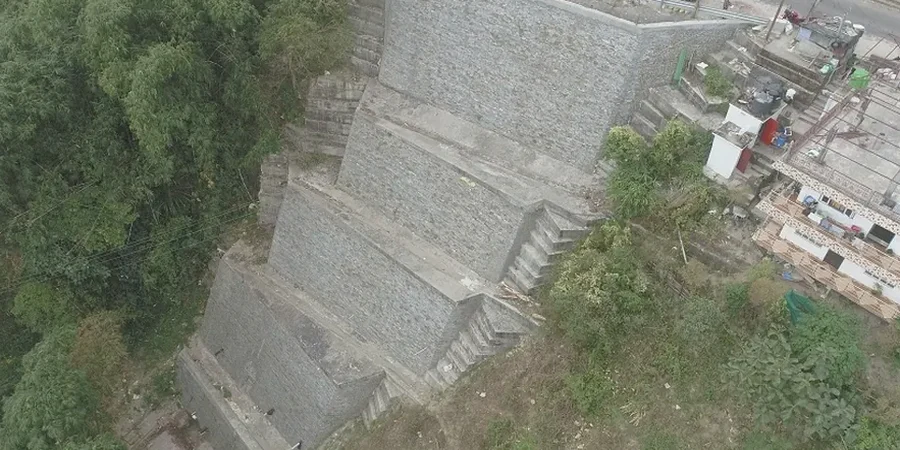
Fontana's rapid expansion northward into the San Gabriel Mountain foothills, where elevations climb past 1,800 feet above the Jurupa Valley floor, has placed thousands of new homes on terrain that demands rigorous geotechnical attention. The 2008 Chino Hills earthquake sequence, which produced a magnitude 5.4 event felt strongly across Fontana, reminded every developer and homeowner here that steep colluvial soils and weathered bedrock can lose significant strength under seismic loading. Our slope stability analysis work in Fontana starts from that reality: mapping the interface between residual soil and decomposed granite, measuring groundwater perched within ancient landslide deposits, and quantifying the factor of safety for both static and pseudo-static conditions. We integrate subsurface data from exploratory borings with laboratory shear strength testing to build models that reflect actual site behavior, not textbook assumptions. For deeper soil profiling in challenging access areas, we often recommend combining our analysis with CPT testing to obtain continuous stratigraphy without disturbing sensitive clay seams, or verifying bedrock depth with seismic refraction surveys along the proposed slope face.
A slope can stand for decades and fail in seconds during the first heavy rain after a wildfire—Fontana's hillsides demand analysis that accounts for both geology and hydrology.
Quick answers
What is the typical cost range for a slope stability analysis on a single residential lot in Fontana?
How does the City of Fontana define when a slope stability report is required?
The Fontana Municipal Code, consistent with California Building Code Section 1808, requires a geotechnical report addressing slope stability for any grading that creates cut or fill slopes steeper than 2:1 or exceeding 5 feet in vertical height. The report must demonstrate a minimum static factor of safety of 1.5 and address seismic stability under the design earthquake specified by the CBC.
What soil types in Fontana create the most slope stability problems?
The most problematic materials we encounter are the claystone layers within the Fernando Formation, which can exhibit residual friction angles below 15 degrees when sheared, and the surficial colluvial deposits that mantle the steeper canyon slopes north of the 210 freeway. These colluvial soils often contain rounded cobbles in a silty matrix that loses cohesion rapidly when saturated.
Can a slope that has already failed be analyzed and repaired to meet current code requirements?
Yes, and we perform these forensic evaluations regularly in Fontana. The process involves mapping the failure scarp and toe bulge, installing inclinometers to locate the active shear surface, sampling the failure plane material for residual strength testing, and designing a remediation strategy—typically involving regrading, drainage improvements, and structural reinforcement at the toe.