← Home · Slopes & Walls

Active/Passive Anchor Design in Fontana CA | Geotechnical Anchoring Systems

Together, we solve the challenges of tomorrow.

LEARN MORE →

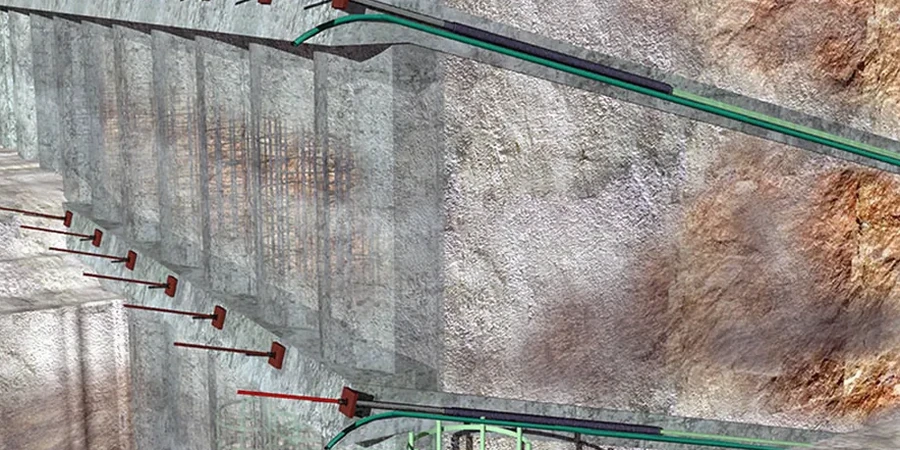
Fontana sits on deep alluvial fan deposits from the San Gabriel and San Bernardino Mountains. The soil profile here—interbedded sands, silts, and coarse gravels—demands a rigorous approach to tieback and rock anchor design. IBC Chapter 18 and ASTM D3966 set the baseline, but local groundwater depth and the city's rapid commercial expansion require additional scrutiny. We design active and passive anchors that transfer tensile loads into competent strata, typically below 15 to 25 feet, bypassing the loose upper layer. Before a single tendon is ordered, our team models bond zone capacity using actual subsurface data, not just textbook friction angles. For projects near the old Kaiser Steel mill area, where fill soils dominate, we often cross-check anchor performance with a CPT test to verify strength profiles before finalizing tendon length.

An anchor is only as reliable as the bond zone it’s grouted into. In Fontana’s stratified gravels, that means verifying capacity at every elevation.
How we work

In Fontana, we frequently see design-build teams specifying an anchor system without confirming whether the soil can sustain the unbonded length. Our load tests reveal that in silty sands common west of Sierra Avenue, creep rates can exceed allowable limits if the bond length isn't adjusted for local fines content. We differentiate between active tendons—pre-stressed to control wall deflection—and passive bars that engage only when the wall begins to move. The choice affects not just wall cost but also the construction sequence. A well-designed active anchor grid can save weeks on a deep excavation schedule by letting you proceed with backfill sooner. Our submittal packages include corrosion protection details per PTI DC35.1, and for projects with retaining walls over 12 feet, we coordinate the anchor free length with the global stability analysis to avoid a compound failure surface.
Active/Passive Anchor Design in Fontana CA | Geotechnical Anchoring Systems
Technical reference image — Fontana

Local geotechnical context

A 10-story mixed-use project along Foothill Boulevard ran into trouble when the original anchor design assumed a uniform sand layer. The contractor hit a buried channel of loose silt at 18 feet, and the proof test on the first three anchors failed at 70% of design load. The fix wasn’t just longer tendons—we re-profiled the bond zone and switched to a staged stressing sequence. This added six days to the excavation schedule and cost the owner in extended shoring rental. The lesson: in Fontana’s alluvial plain, assuming homogeneity is the fastest way to blow your budget. We now require a sacrificial anchor test before production drilling begins on any site east of Juniper Avenue.

Need a geotechnical assessment?

Reply within 24h.

Email: contact@geotechnicalengineering1.com

Technical parameters

ParameterTypical value
Anchor typeActive (pre-stressed) / Passive
Bar sizes evaluated#8 to #14 (Grade 75/150 ksi)
Bond length in sands15–30 ft per load test data
Creep limit (ASTM D3966)≤ 1.0 mm over log cycle
Corrosion protectionClass I (PTI DC35.1)
Typical design load range50–180 kips per tendon
Proof test frequency100% of production anchors

Other technical services

01

Design-Build Anchor Packages

Complete submittal for active and passive tiebacks. Includes bond length calculations, tendon sizing, and corrosion protection class specification per PTI DC35.1. We handle the plan check process with Fontana’s building department.

02

Anchor Load Testing & Verification

Performance, proof, and extended creep tests per ASTM D3966. We provide a field engineer during testing to interpret load-displacement curves and confirm lock-off load on the spot.

03

Forensic Anchor Evaluation

When an anchor fails proof test or a wall shows unexpected movement, we mobilize to perform lift-off tests and re-evaluate the bond zone with supplementary site investigation.

Applicable standards

ASTM D3966-07: Standard Test Methods for Deep Foundations Under Lateral Load, IBC 2024 Chapter 18: Soils and Foundations, PTI DC35.1-20: Recommendations for Prestressed Rock and Soil Anchors, ASCE 7-22 Minimum Design Loads, ASTM A615/A615M: Deformed and Plain Carbon-Steel Bars

Quick answers

What does active/passive anchor design cost in Fontana?
How many proof tests does IBC require on a Fontana project?

IBC 2024 mandates that 100% of production anchors be proof tested to 133% of design load, with a minimum hold period of 10 minutes. In Fontana’s alluvial soils, we typically recommend extending the hold to 60 minutes on the first three anchors to establish a site-specific creep baseline.

Can you design anchors for temporary shoring walls in Fontana?

Yes. Temporary tieback anchors for soldier pile and lagging walls are a routine part of our practice. We specify the required free length to ensure the bond zone starts behind the active failure wedge, even with a 1H:1V surcharge from adjacent structures.

What happens if an anchor fails the performance test?

We respond immediately. Our field team performs a lift-off test on the failed anchor and re-evaluates the bond zone stratigraphy. Often the solution involves extending the bond length or switching to a pressure-grouted installation method to increase unit skin friction in Fontana’s silty interbeds.

Location and service area

We serve projects across Fontana and surrounding areas.

View larger map