← Home · Underground Excavations

Geotechnical Design of Deep Excavations in Fontana, CA

Together, we solve the challenges of tomorrow.

LEARN MORE →

Fontana sits atop the massive alluvial fan of Lytle Creek, where soil profiles can swing from clean sands to gravelly silts within a few hundred feet. IBC Chapter 18 and OSHA Subpart P both demand a site-specific geotechnical design before any cut exceeds five feet, but in this city the real challenge is water. Between the Santa Ana River influence and historic irrigation, perched groundwater shows up where boring logs don't predict it. Our team runs the full ASTM D2487 classification on every sample, ties the lateral earth pressure envelope to the actual friction angle measured in our triaxial cell, and builds the shoring model around the seismic coefficient your structural engineer needs. When the excavation goes deeper than fifteen feet on Sierra Avenue or near the 210 corridor, we layer in the MASW shear-wave velocity profile to nail down the site class for the shoring design—because a Class D assumption that works fine for footings can blow out your soldier pile embedment depth if the real VS30 sits in Class C territory.

In Fontana's alluvial fan deposits, a single missed sand lens can change the design groundwater level by eight feet and double the required embedment depth.

How we work

The contrast between the older residential grid south of Foothill Boulevard and the newer industrial parcels north of the 210 freeway defines how we approach Fontana excavations. South of Foothill, we routinely encounter stiff, desiccated alluvium with blow counts above 30—material that stands well on a 0.25H:1V cut for weeks if kept dry. North of the freeway, the upper twenty feet often include loose windblown sands and undocumented fill from the 1970s warehouse boom. Those sands lose apparent cohesion the moment they get wet, and we have watched a benched slope unravel in an afternoon storm. To bracket the behavior, we run consolidated-undrained triaxial on Shelby tube samples from the upper silty zone and pair that data with field CPT test soundings that give us a continuous tip resistance profile. The CPT picks up thin sand lenses that a six-foot split-spoon interval can miss, and those lenses control the phreatic surface in the shoring model. Our shoring submittals to the City of Fontana Building & Safety Division always include a cross-section with the actual stratigraphy, the design groundwater elevation, and the corresponding apparent earth pressure diagram—no generic trapezoid copied from a manual.
Geotechnical Design of Deep Excavations in Fontana, CA
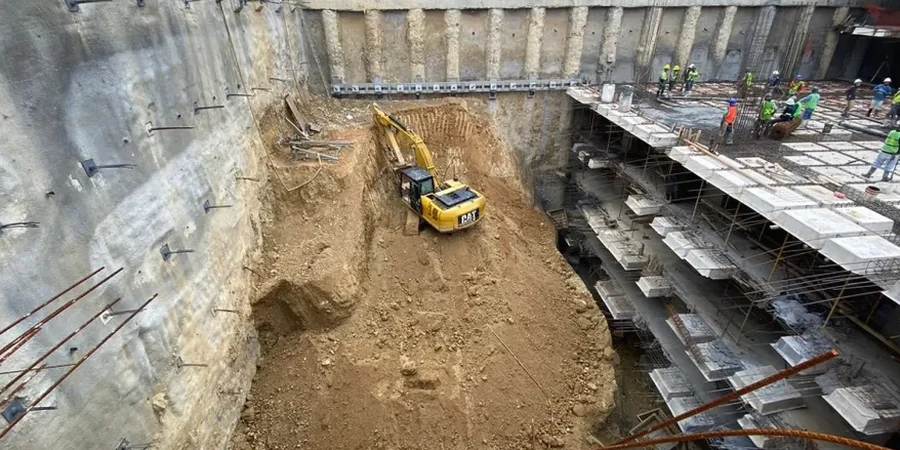
Technical reference image — Fontana

Local geotechnical context

A twelve-story mixed-use project on Baseline Road planned a two-level basement with a thirty-two-foot cut directly adjacent to a 1960s masonry building on spread footings. The geotechnical baseline report assumed a simple cantilever soldier pile wall, but our inclinometer readings during a nearby pilot excavation showed lateral movements exceeding an inch at just eighteen feet of cut. The culprit was a five-foot-thick layer of saturated silty sand at the fifteen-foot depth that had drained into the excavation, softening the passive wedge. We redesigned the shoring with a row of high-capacity tiebacks at the fourteen-foot level and added a compaction grout curtain beneath the neighbor's footing line. The final lateral deflection stayed under half an inch. That job illustrates why Fontana deep excavations demand real-time monitoring and a design team that can pivot when the stratigraphy misbehaves. Relying solely on a pre-construction boring log without observation wells is a gamble that the alluvial fan rarely rewards.

Need a geotechnical assessment?

Reply within 24h.

Email: contact@geotechnicalengineering1.com

Technical parameters

ParameterTypical value
Design groundwater elevationPerched at 12–22 ft bgs, seasonal variation ±4 ft
Active earth pressure coefficient (Ka)0.26–0.33 (Coulomb, δ = 0.5φ)
Passive resistance (Kp)3.0–5.5, reduced per FHWA for permanent walls
Seismic coefficient (kh)0.15–0.22 per ASCE 7-22 site class
Maximum unsupported cut height (temporary)8 ft in granular soil, 12 ft in stiff alluvium
Soldier pile embedment (typical)1.2H to 1.5H below subgrade
Typical shoring systemSoldier pile & lagging with tiebacks at 14-ft vertical spacing

Other technical services

01

Shoring design and submittal packages

Complete soldier pile, sheet pile, and secant wall designs with apparent earth pressure diagrams, waler sizing, and tieback spacing calculations. All packages are sealed by a California-licensed geotechnical engineer and formatted for City of Fontana plan check.

02

Pre-excavation site characterization

Rotary wash borings with SPT sampling at five-foot intervals, CPT soundings to 80 feet, and installation of vibrating-wire piezometers for long-term groundwater monitoring during the construction phase.

03

Laboratory strength testing

Consolidated-undrained triaxial compression (ASTM D4767), direct shear on undisturbed samples, and Atterberg limits to confirm the plasticity index used in the active-pressure calculation.

04

Construction-phase monitoring

Inclinometer casings, optical survey points on adjacent structures, and load cells on tiebacks. We provide weekly reports with movement plots and trigger-level alerts tied to the project's threshold criteria.

Applicable standards

ASCE 7-22 (Seismic lateral earth pressure), IBC 2021 Chapter 18 (Soils and foundations), ASTM D1586-18 (Standard Penetration Test), ASTM D2487-17 (Unified Soil Classification), FHWA GEC No. 4 (Ground anchors and anchored systems), Caltrans Trenching & Shoring Manual (2023)

Quick answers

How much does a geotechnical design for a deep excavation cost in Fontana?
How deep can you excavate before needing a shoring design in Fontana?

OSHA requires a protective system for any excavation deeper than five feet, and the City of Fontana typically triggers a shoring plan review for cuts over eight feet or any depth that could affect the public right-of-way. For cuts exceeding twelve feet, a California-licensed engineer must seal the design.

What type of shoring works best in Fontana's alluvial soils?

Soldier pile and lagging with tiebacks is our most common system for cuts deeper than fifteen feet. The alluvial fan deposits generally provide good passive resistance below twenty feet, but the upper loose sands often require a row of tiebacks to limit deflection. In areas with high groundwater, we evaluate secant pile walls to control seepage.

How long does it take to get a shoring submittal approved by the City of Fontana?

Plan check turnaround at the Building & Safety Division typically runs three to four weeks for a first review. We expedite the process by including the geotechnical data report, the shoring calculations, and the construction-phase monitoring plan in a single package, which reduces the back-and-forth that occurs when these items are submitted separately.
Location and service area

We serve projects across Fontana and surrounding areas.

View larger map