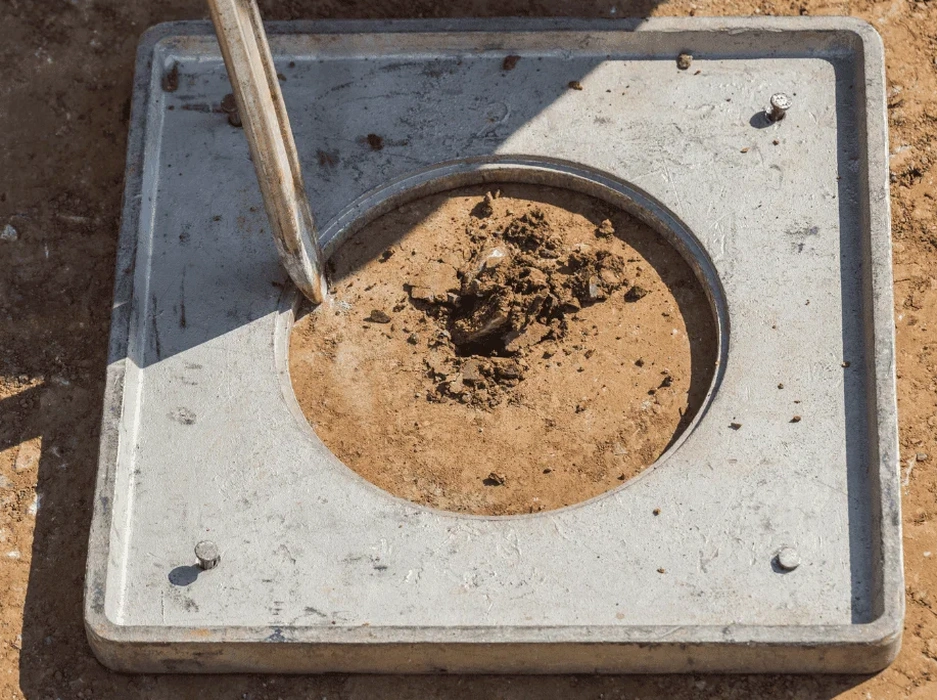
A six-story medical office building being reviewed off Sierra Avenue required a site-specific liquefaction assessment after preliminary borings encountered loose silty sand to a depth of 42 feet below the existing pad grade. The geotechnical report had flagged groundwater at 11 feet, and with Fontana sitting within the Inland Empire’s seismically active corridor—less than 8 miles from the San Jacinto fault zone—the structural engineer needed more than a screening-level check. We mobilized a track-mounted drill rig for SPT sampling using an automatic trip hammer calibrated to ASTM D1586-18 energy ratios, retrieving split-spoon samples at 2.5-foot intervals through the critical Holocene alluvium. The SPT drilling data fed into a Seed-Idriss simplified procedure, yielding factors of safety below 1.0 for the 2,475-year return period. Grain size curves from wash-sieving confirmed less than 12 percent fines, a texture that correlates strongly with contractive behavior under cyclic loading. To complement the field campaign, we recommended a triaxial testing program on undisturbed thin-walled tube specimens, running stress-controlled cyclic triaxial tests at confining pressures matching the in-situ overburden. The results quantified excess pore pressure ratios exceeding 0.9 within 8 uniform cycles, confirming that ground improvement would be mandatory before foundation construction could proceed.
In Fontana’s Quaternary alluvium with groundwater above 15 feet, SPT-based liquefaction triggering analyses routinely show factors of safety below 0.8 for a 2,475-year event, requiring engineered ground improvement.
Local geotechnical context
ASCE 7-22 Section 11.8.3 mandates liquefaction assessment for Seismic Design Category D through F when the mapped spectral accelerations and subsurface conditions trigger the screening criteria, and Fontana sites with shallow groundwater in loose granular deposits fall squarely into this requirement. The probabilistic seismic hazard for the 34.09°N, 117.43°W location, governed by the San Jacinto and Cucamonga fault contributions, produces a PGA of roughly 0.65g at the MCE_R level, enough to initiate excess pore pressure in contractive sands within the first few seconds of strong shaking. The most severe consequence is not bearing failure but differential settlement caused by uneven thickness of liquefied layers across the building footprint—we have seen tilt angles exceeding 1/200 in forensic cases where this hazard was overlooked during design. Lateral spreading toward the Lytle Creek wash or any open excavation presents an additional kinematic demand on deep foundations, which is why our reports include displacement estimates using the Youd empirical model. The IBC 2021 directs the engineer of record to either mitigate the risk through densification, drainage, or reinforcement, or to design the structural system to accommodate the anticipated ground deformation, a decision that depends entirely on the precision of the site-specific liquefaction analysis.
Standards that apply
ASCE 7-22, Chapter 11 & 21 (Seismic Design & Site-Specific Procedures), IBC 2021, Section 1803.5.12 (Liquefaction Potential), ASTM D1586-18 (Standard Penetration Test), ASTM D2487-17 (Unified Soil Classification System), ASTM D5311/D5311M-13 (Cyclic Triaxial for Liquefaction)
Quick answers
What triggers a liquefaction study requirement in Fontana per the building code?
The IBC 2021, referencing ASCE 7-22, requires a liquefaction evaluation when the site class is D, E, or F, the groundwater table is within 50 feet of grade, and the mapped S1 spectral acceleration exceeds 0.2g. Most of Fontana's valley-floor parcels meet these criteria because the Quaternary alluvium contains loose sand lenses and the design PGA for the MCE_R event is in the 0.55–0.75g range. A screening-level Factor of Safety below 1.2 typically triggers the full site-specific analysis.
How much does a liquefaction analysis cost for a typical Fontana commercial lot?
What is the difference between a screening analysis and a full quantitative liquefaction assessment?
A screening applies simplified criteria—grain size, relative density, groundwater depth—to judge susceptibility qualitatively, often using the Chinese Criteria or Bray & Sancio framework. A full quantitative assessment computes CSR from site-specific PGA and total/effective stress profiles, determines CRR from corrected SPT blow counts or lab cyclic strength, and delivers a factor of safety per layer plus deformation estimates. The IBC demands the full quantitative approach when the screening cannot rule out potential with a high degree of confidence, which is the case for most Fontana sites with SPT N-values below 15 in saturated sand.
Can ground improvement eliminate the liquefaction hazard completely on a Fontana site?
Techniques like vibro-compaction, stone columns, or deep soil mixing can increase the in-situ density and drainage capacity enough to push the factor of safety above the code-required threshold, typically 1.1 to 1.3 depending on the risk category. While no method guarantees absolute zero excess pore pressure under extreme shaking, a properly designed improvement program validated with post-treatment SPT or CPT verification testing reduces the residual settlement to tolerable levels for conventional shallow foundations.