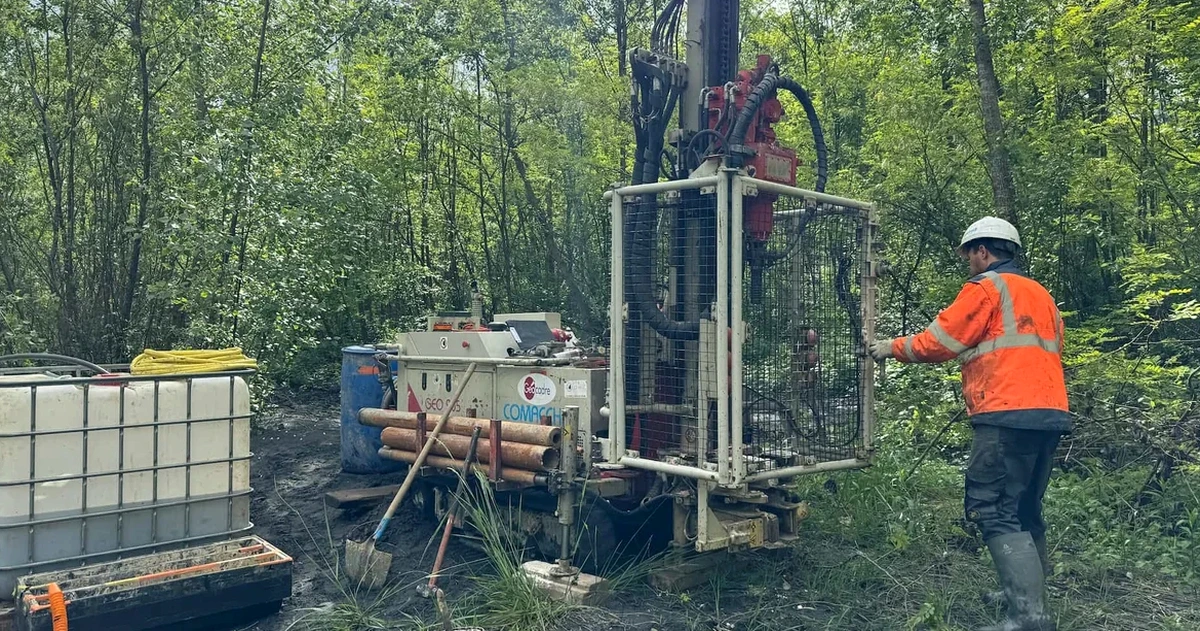
The alluvial fan deposits under Fontana tell a story of coarse gravels mixed with silty fines washed down from the San Gabriels, and that mix creates real headaches when you’re trying to nail down bearing capacity. A proper soil mechanics study in Fontana has to account for the rapid transition from granular to cohesive behavior within the same site—something we see constantly working the corridor between the 210 and 10 freeways. Our lab runs the full suite on Shelby tube samples and bulk bags: triaxial compression under consolidated-undrained conditions, incremental oedometer loading, and direct shear on undisturbed specimens. Before the lab phase, we pair the sampling program with SPT drilling so the field N-values and recovery ratios give context to every stress-strain curve we plot back at the bench.
A soil mechanics study in Fontana means reconciling coarse Cajon Creek gravels with fine silty seams — skip the consolidation curve and you miss the settlement story.
Quick answers
How much does a soil mechanics study cost in Fontana?
What soil units in Fontana require triaxial testing?
The silty sands and low-plasticity clays interbedded within the Cajon Creek alluvium are prime candidates. Any unit that will carry foundation load in undrained or partially drained conditions should be tested for the Mohr-Coulomb envelope.
How long does the lab testing phase take?
Consolidation tests run three to ten days depending on the load increments. Triaxial with pore pressure measurement typically takes four to seven days per specimen. A full Fontana soil mechanics study, from sample receipt to final report, usually spans three to four weeks.
Do you handle sampling coordination for the soil mechanics study?
We coordinate directly with the drilling crew on site in Fontana. Our lab provides Shelby tube handling instructions, sample extrusion protocols, and chain-of-custody documentation so the specimens arrive undisturbed and properly sealed.
Can you test gravelly soils from Fontana's alluvial fans?
Yes, but the approach shifts. For gravel-dominant units we use large-diameter direct shear (ASTM D3080) on recomposited specimens or large triaxial cells when the particle size allows. The report clearly flags any scaling limitations from oversized clasts.