← Home · Ground improvement

Stone Column Design in Fontana CA – Ground Improvement for Weak Soils

Together, we solve the challenges of tomorrow.

LEARN MORE →

Fontana sits on the distal alluvial fan of Lytle Creek and the Cucamonga wash, where loose to medium-dense sands and interbedded silts dominate the upper 15 to 25 feet. Groundwater in the southern industrial corridor can appear as shallow as 8 feet below grade during wet years, complicating conventional shallow foundations. When SPT blow counts dip below 8 in the upper 20 feet and the site sits within Seismic Design Category D per ASCE 7-22, stone column design becomes a practical alternative to deep foundations. The team assesses grain-size distribution from grain size laboratory data and field logs to confirm vibro-replacement feasibility before any layout is drafted. In Fontana, more than a dozen logistics centers and tilt-up warehouses have relied on this technique to keep differential settlement under 1 inch while meeting the IBC 2022 requirement for improved ground.

When SPT N-values sit below 8 and groundwater is at 8 feet, stone columns can raise the composite friction angle above 38 degrees and cut post-seismic settlement by 60 percent or more.
How we work

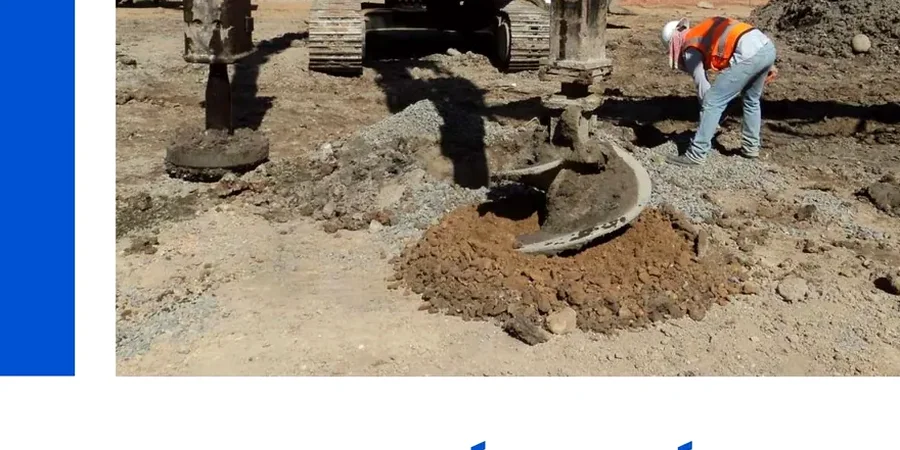
A common observation from Fontana sites is that the natural soil matrix rarely drains well enough for rapid excess pore-pressure dissipation during an earthquake. That reality shifts the design focus from simple bearing-capacity improvement to liquefaction mitigation. We run SPT-based liquefaction triggering analyses following the NCEER/Youd-Idriss 2001 procedure, then size the stone columns to achieve a target area replacement ratio between 10 and 25 percent depending on the fines content. The liquefaction assessment defines the required post-treatment factor of safety, typically 1.2 to 1.3 for critical structures. Column grids are spaced at 5 to 8 feet on center, installed by wet top-feed vibroflot, and backfilled with clean, angular crushed rock meeting Caltrans Class 2 permeability specs. A load test on a two-column group verifies that the composite shear modulus falls within 5 percent of the design value before production work covers the full footprint.
Stone Column Design in Fontana CA – Ground Improvement for Weak Soils
Technical reference image — Fontana

Local geotechnical context

Sites north of Foothill Boulevard often encounter denser Pleistocene alluvium with SPT N-values above 20 by 15 feet, making stone columns less cost-competitive than rammed aggregate piers. South of Baseline, where Holocene deposits extend deeper and the water table rises, the same technique becomes the logical first choice. The biggest risk in Fontana is underestimating the silt content: once fines exceed 20 percent, radial drainage slows and the design must shift from a purely drainage-focused solution to a reinforcement approach with larger replacement ratios. A pre-production test section with CPT verification catches this before it becomes a change-order problem. The team also watches for buried cobble lenses from the Lytle Creek fan that can deflect a vibroflot and leave untreated windows in the grid.

Need a geotechnical assessment?

Reply within 24h.

Email: contact@geotechnicalengineering1.com

Technical parameters

ParameterTypical value
Design depth range15–35 ft below grade
Area replacement ratio (typical)10–25%
Column diameter30–42 inches
Center-to-center spacing5–8 ft (triangular grid)
Backfill gradationCaltrans Class 2 permeable (1.5–3 in)
Target composite friction angle≥ 38°
Post-treatment SPT N₁(60)> 15 blows/ft
Liquefaction factor of safety (target)≥ 1.2–1.3

Other technical services

01

SPT-Based Subsurface Characterization

Drilling to 40 feet with SPT sampling at 2.5-foot intervals to map blow-count profiles, identify liquefiable layers, and measure groundwater depth for input into the design model.

02

Grain-Size and Fines Content Analysis

Sieve and hydrometer testing per ASTM D6913/D7928 to quantify percent fines, confirm drainage viability, and select the appropriate vibro-replacement approach – top-feed or bottom-feed.

03

Liquefaction Triggering and Settlement Analysis

Cyclic stress ratio evaluation using SPT data and the NCEER procedure, coupled with post-improvement settlement estimates from Tokimatsu-Seed and Ishihara methodologies.

04

Load Test and CPT Verification

Two-column group load test with settlement monitoring plus CPT soundings at the column center and midpoint to confirm composite shear modulus and treatment uniformity before full production.

Applicable standards

ASTM D1586-18 (Standard Penetration Test), ASCE 7-22 (Minimum Design Loads – Seismic), IBC 2022 (Section 1806 – Ground Improvement), NCEER/Youd-Idriss 2001 (Liquefaction triggering), Caltrans Standard Specifications (Class 2 permeable backfill)

Quick answers

What is the typical cost range for stone column design and testing in Fontana?
How deep do stone columns need to go in Fontana to address liquefaction?

The treatment depth follows the liquefiable layer extent. In Fontana, that usually means extending columns to 25–35 feet below grade, where Holocene alluvium transitions to denser Pleistocene deposits. The exact bottom elevation is set by the SPT N-value profile and the calculated critical layer from the triggering analysis.

What backfill material is specified for stone columns in the Inland Empire?

We specify clean, angular crushed rock meeting Caltrans Class 2 permeability gradation – typically 1.5 to 3 inches with less than 5 percent passing the No. 200 sieve. The high angularity maximizes interlock and the low fines content ensures drainage capacity stays above 0.2 cm/s long-term.

Location and service area

We serve projects across Fontana and surrounding areas.

View larger map