← Home · Foundations

Pile Foundation Design in Fontana, CA – Geotechnical Engineering for Deep Foundations

Together, we solve the challenges of tomorrow.

LEARN MORE →

IBC Chapter 18 and ASCE 7-22 Section 12.13.4 leave no room for guesswork when bearing strata lie 40 feet below grade. Fontana sits on the distal portion of the Cucamonga alluvial fan, where granular deposits alternate with silty lenses deposited by Lytle Creek over millennia. Shallow footings drift and crack here—we see it every season in older industrial buildings along Valley Boulevard. A pile foundation must bypass the upper 30 feet of loose to medium-dense alluvium and socket into competent Pleistocene conglomerate. Groundwater fluctuates seasonally from 25 to 45 feet, which shifts effective stress and demands careful shaft resistance calculations. For warehouse and logistics centers in the Kaiser Steel redevelopment zone, we often pair CPT sounding with rotary wash borings to build a continuous strength profile before selecting pile type and tip elevation. The site class D or E profile typical of this corridor makes dynamic amplification a real factor in axial design.

A pile that terminates in dense Pleistocene conglomerate at Fontana delivers three times the end bearing of a footing on medium-dense alluvium—and eliminates seasonal heave risk.

How we work

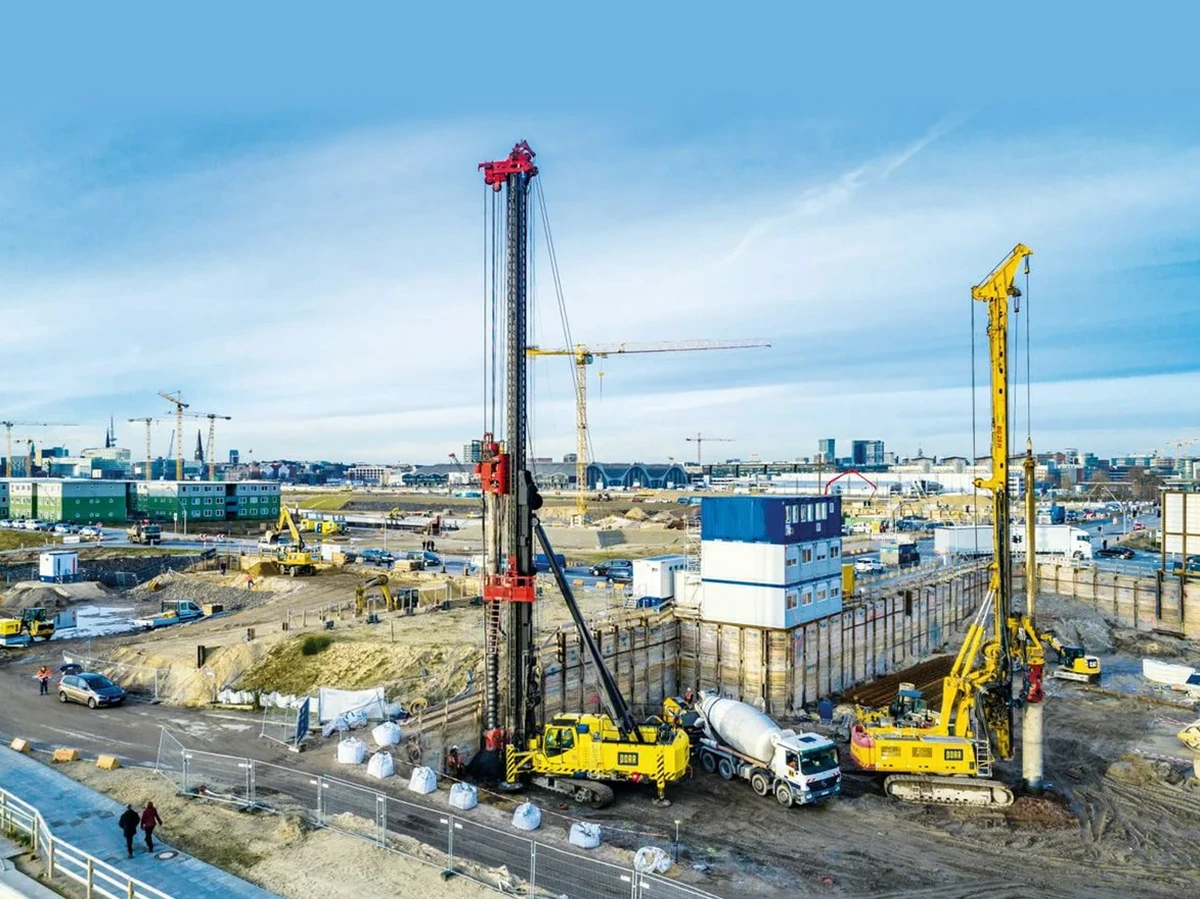
Our field team deploys a CME-75 track-mounted drill rig with automatic SPT hammer for boring to 80 feet through Fontana’s cobble-rich fan deposits. Hollow-stem augers keep the hole open in collapsing sands below 15 feet, while Shelby tubes extract undisturbed samples from cohesive interbeds. In the lab, we run unconsolidated-undrained triaxial tests at confining pressures matching the design depth, then feed the undrained shear strength directly into FHWA Driven and Drilled Shaft manuals for side friction and end bearing. Elastic settlement checks use the modified Hough method with strain influence factors calibrated to the decomposed granite bedrock underlying the fan. For structures within the 1.5 km-wide Alquist-Priolo zone trace mapped near Sierra Avenue, we incorporate lateral spreading demands from liquefaction analysis into the pile group deflection envelope. Every report includes LRFD resistance factors and a constructability review covering casing requirements, drilling fluid loss risk, and vibration limits near active rail corridors.
Pile Foundation Design in Fontana, CA – Geotechnical Engineering for Deep Foundations
Technical reference image — Fontana

Local geotechnical context

Fontana’s alluvial fan deposits contain discontinuous layers of clean sand and low-plasticity silt that reach a factor of safety below 1.1 under the MCE spectral acceleration of 1.50g defined for the city in ASCE 7-22. Post-liquefaction settlement of 2 to 6 inches can shear pile caps and disconnect grade beams from the superstructure. We run the Youd-Idriss simplified procedure with SPT blow counts corrected for fines content and overburden, then compute residual strength using the Olson-Stark correlation. Negative skin friction from consolidating fill—common on former agricultural parcels south of the 10 freeway—adds drag load that must be subtracted from structural capacity. A pile design that ignores these two mechanisms looks safe on paper and fails within three years of service.

Need a geotechnical assessment?

Reply within 24h.

Email: contact@geotechnicalengineering1.com

Technical parameters

ParameterTypical value
Boring depth range50 to 90 ft below grade
SPT N-values in upper alluvium8 to 22 blows/ft
Target bearing stratumPleistocene conglomerate (N>50)
Groundwater depth (seasonal)25 to 45 ft
Seismic site class (typical)D (ASCE 7-22)
Unconfined compressive strength (conglomerate)2,500 to 5,000 psi
Skin friction range (drilled shafts, alluvium)0.5 to 1.8 ksf
Liquefaction depth interval analyzed0 to 40 ft

Other technical services

01

Geotechnical Investigation for Pile Design

Rotary wash borings, SPT sampling, and CPT soundings to map depth to competent conglomerate and characterize all layers influencing pile performance.

02

Axial Capacity and Settlement Analysis

Side friction and end bearing calculations per FHWA methods, coupled with elastic settlement and downdrag estimates for consolidating soils.

03

Lateral Load and Liquefaction Checks

P-y curve analysis for seismic and wind demands, plus post-liquefaction residual strength input for pile group stability under MCE conditions.

04

Construction Specifications and QA/QC

Pile installation criteria, casing and slurry protocols, dynamic testing specifications, and inspection checklists aligned with IBC special inspection requirements.

Applicable standards

IBC 2024 Chapter 18 – Soils and Foundations, ASCE 7-22 Section 12.13 – Deep Foundations, ASTM D1586-18 – Standard Penetration Test, ASTM D2487-17 – Unified Soil Classification, FHWA-NHI-10-016 – Drilled Shafts, NCEER/Youd-Idriss 2001 – Liquefaction Triggering

Quick answers

How deep do piles typically need to go in Fontana?

Most pile foundations in Fontana extend 50 to 75 feet to reach dense Pleistocene conglomerate. The exact depth depends on the thickness of loose alluvial cover at your site, which varies from 30 to 55 feet across the fan. We confirm target depth through exploratory borings and CPT soundings.

What is the cost range for pile foundation design in Fontana?
Does Fontana require liquefaction analysis for pile foundations?

Yes, the upper 40 feet of alluvial soil in most of Fontana is susceptible to liquefaction under the design earthquake. IBC and ASCE 7-22 mandate a site-specific liquefaction evaluation for deep foundations. Our design includes residual strength estimates and lateral spreading demands applied to the pile group.

Which pile types are most suitable for Fontana soils?

Drilled cast-in-place shafts and driven concrete piles both work well here. Drilled shafts socketed into conglomerate offer high end bearing, while driven piles can achieve capacity through dense alluvium. The choice depends on access, vibration limits near existing structures, and groundwater conditions.

How long does the investigation and design process take?

Fieldwork and lab testing are completed in 10 to 15 working days. The engineering report with pile capacities, settlement analysis, and construction specifications follows 10 to 12 working days after lab data is finalized, totaling approximately four to five weeks.
Location and service area

We serve projects across Fontana and surrounding areas.

View larger map