Together, we solve the challenges of tomorrow.
LEARN MORE →Ground improvement encompasses a suite of geotechnical techniques aimed at enhancing the engineering properties of soil and fill materials to support structural loads safely and economically. In Fontana, California, where rapid urban growth and logistics infrastructure continue to expand across the Inland Empire, these methods are critical for transforming marginal sites into buildable land. From warehouse distribution centers to residential subdivisions, the ability to modify weak or compressible soils directly influences project feasibility, foundation design, and long-term performance. Ground improvement reduces settlement potential, increases bearing capacity, and mitigates liquefaction risks, making it a cornerstone of modern construction in this seismically active region.
Fontana sits within the upper Santa Ana River basin, an area shaped by alluvial fan deposits, ancient stream channels, and variable Quaternary sediments. Much of the city is underlain by loose to medium-dense sands, silty sands, and soft clays that can extend tens of feet below the surface. These soils are particularly susceptible to settlement under load and, critically, to liquefaction during earthquake shaking given the proximity to the San Andreas and San Jacinto fault systems. The groundwater table across many parts of Fontana is relatively shallow, compounding the challenge for excavation and foundation work. Such subsurface conditions demand rigorous geotechnical investigation and often necessitate ground improvement to meet structural performance criteria.
Design and execution of ground improvement in Fontana must comply with the California Building Code (CBC), which adopts and amends the International Building Code (IBC) with state-specific seismic provisions. Chapter 18 of the CBC governs soils and foundations, while ASCE 7-16 provides the basis for seismic ground motion and liquefaction assessment. Local municipalities, including the City of Fontana, may impose additional grading and drainage requirements through their public works departments. For projects involving deeper soil treatment, such as stone column design, adherence to FHWA and ASTM standards for material testing and installation quality control is mandatory. These regulations ensure that ground improvement solutions are engineered to withstand both static and dynamic loads over the design life of the structure.
A wide range of project types in Fontana benefit from ground improvement. Tilt-up concrete warehouses and big-box retail structures, prevalent in the area due to the logistics boom, often require improved ground to support heavy floor slabs and racking systems without differential settlement. Infrastructure projects such as bridge approaches, roadway embankments, and stormwater detention basins must address soft soil conditions to prevent long-term deformation. For sites with loose granular soils, vibrocompaction design offers a proven method to densify deposits and increase relative density, effectively reducing the risk of seismic-induced settlement. Residential developments on former agricultural or undisturbed alluvial land similarly rely on ground improvement to meet foundation performance standards without resorting to costly deep foundations.
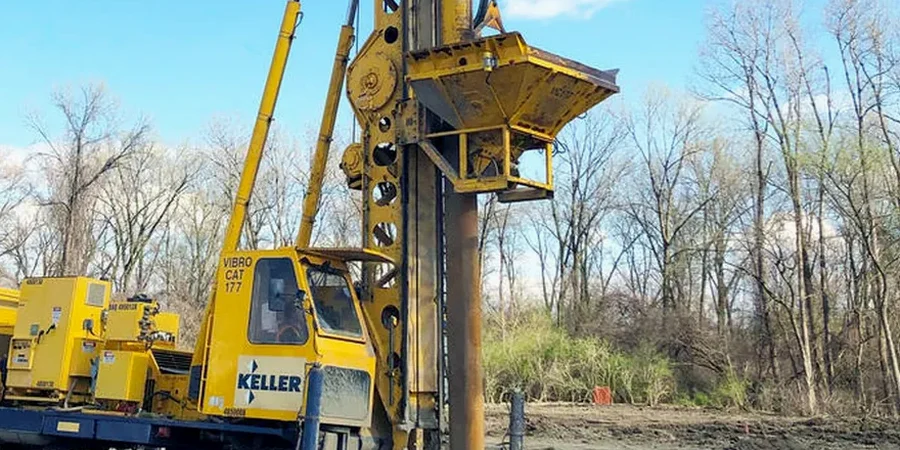
For loose, saturated sandy soils common in Fontana, vibrocompaction and stone columns are highly effective. Vibrocompaction densifies granular soils through vibration, while stone columns both densify and provide drainage paths to dissipate excess pore pressures. The choice depends on fines content, depth to groundwater, and proximity to existing structures.
A geotechnical investigation including borings, Standard Penetration Tests, and laboratory analysis will evaluate soil strength, compressibility, and liquefaction potential. If calculated settlements exceed tolerable limits or bearing capacity is insufficient for the proposed loads, ground improvement becomes necessary to meet safety and serviceability requirements.
Modern ground improvement methods like vibrocompaction and stone columns generate minimal spoil and use locally sourced materials, reducing truck traffic and landfill disposal. They also eliminate the need for extensive excavation and soil replacement, lowering the carbon footprint compared to traditional deep foundation alternatives.
Timelines vary with site size, soil conditions, and treatment depth. A typical warehouse site of 5 to 10 acres might require 2 to 4 weeks of field work for vibrocompaction or stone column installation, excluding mobilization, quality control testing, and subgrade preparation. Early contractor involvement helps optimize scheduling.