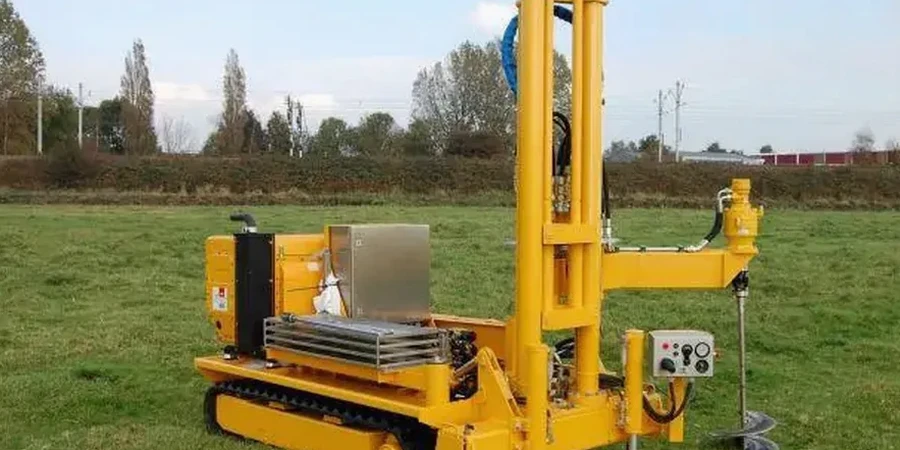
Fontana sits at 1,237 feet on the alluvial fan of Lytle Creek, where the San Bernardino Basin drops coarse gravels and interbedded silts in layers no driller can really predict from the surface. The 1992 Landers and Big Bear sequences reminded everyone in the Inland Empire that basin effects amplify shaking, and standard SPT blow counts alone don't capture the continuous stratigraphy we need for liquefaction triggering analysis. We run the CPT cone here because it gives us a nearly uninterrupted profile of tip resistance, sleeve friction, and pore pressure—three channels of data that let us flag thin liquefiable lenses a split-spoon sampler would miss entirely. When the liquefaction assessment demands Seed-Idriss simplified procedure inputs, the CPT provides the normalized CPT penetration resistance directly, without the energy corrections and hammer variability inherent in SPT work. For shallow foundations on the compressible silts near the Santa Ana River wash, we often pair the CPT with footing design that relies on continuous bearing capacity profiles rather than discrete depth intervals.
Continuous cone data catches the thin liquefiable silt seam at 23 feet that a split-spoon sampler would have missed—and in Fontana basin soils, that seam can control the entire seismic settlement analysis.
How we work
What we often notice on Fontana jobsites north of the I-10 is that refusal can come unpredictably—sometimes at 40 feet in dense cobble layers, sometimes at 80 feet in cemented older fan deposits. That variability is exactly why the cone's continuous push matters. Every centimeter of penetration gets recorded, so we can identify a thin clay seam at 23 feet that would control settlement, even if a boring log would have lumped it into a five-foot interval. We run a 20-tonne CPT rig with a standard 15 cm² cone, measuring pore pressure at the u2 position behind the tip, which lets us correct tip resistance in soft saturated silts and also run dissipation tests to estimate in-situ hydraulic conductivity. The data streams in real time, and we plot corrected tip resistance (qt), friction ratio (Rf), and normalized soil behavior type (SBTn) on Robertson charts right on the laptop while the push is still in progress. For sites where the geotechnical baseline includes possible artesian conditions at depth, the pore pressure channel becomes a safety tool as much as a design input.
Local geotechnical context
Fontana's groundwater sits relatively deep in the northern fan—often below 80 feet—but rises significantly toward the Santa Ana River corridor and in the southern industrial zones near Jurupa. That perched or fluctuating water table complicates liquefaction assessment because a soil that drains freely in August might be fully saturated in March after an atmospheric river event. The CPT pore pressure transducer reads this directly: a rising u2 baseline during the push tells us we've entered a saturated zone, and a slow dissipation curve tells us the soil will not drain quickly during cyclic loading. Another risk we track here is the presence of caliche layers—calcium carbonate-cemented horizons that can fool a driller into thinking they've hit bedrock, but which the CPT friction ratio identifies clearly as a cemented soil, not rock. Misclassifying caliche as refusal depth leads to foundation designs that ignore compressible material beneath, and in a seismic event, that's the kind of mistake that shows up as differential settlement across a tilt-up warehouse slab.
Quick answers
How much does a CPT test in Fontana typically cost?
What depth can you reach with the CPT cone in Fontana soils?
It depends entirely on the subsurface. In the finer-grained silts and sands south of Baseline Avenue, we routinely reach 60 to 80 feet without refusal. In the northern fan areas closer to the San Gabriel Mountain front, coarse gravels and cobbles from Lytle Creek can stop the cone at 25 to 40 feet. We always bring a pre-drilling capability for those sites: if refusal occurs in a gravel layer we need to penetrate, we can auger through the obstruction and resume the CPT push to the target depth.
Can CPT data be used for liquefaction analysis in Fontana?
Yes, and that's one of the primary reasons we recommend CPT over SPT in this basin. The Robertson and Wride (1998) procedure—endorsed by the NCEER workshop—uses normalized CPT tip resistance and friction ratio directly to calculate the cyclic resistance ratio (CRR). Because the CPT provides a continuous profile, we can identify thin liquefiable layers that the Seed-Idriss simplified procedure would smear across a broader interval if using SPT data. For Fontana sites within the Alquist-Priolo liquefaction hazard zones mapped by the California Geological Survey, CPT-based analysis is often the preferred method in geotechnical reports submitted to the City of Fontana Building and Safety Division.
How long does a CPT test take on site?
A single 50-foot push with two dissipation tests—each lasting 5 to 10 minutes depending on soil permeability—takes about 45 to 60 minutes of actual penetration time. With rig setup, leveling, and breakdown, plan on roughly two hours per push location. If we're running seismic CPT with shear wave measurements at every meter, add about 15 minutes per push for the hammer strike sequences. Most single-family lot investigations with two CPT locations wrap up in half a day on site.