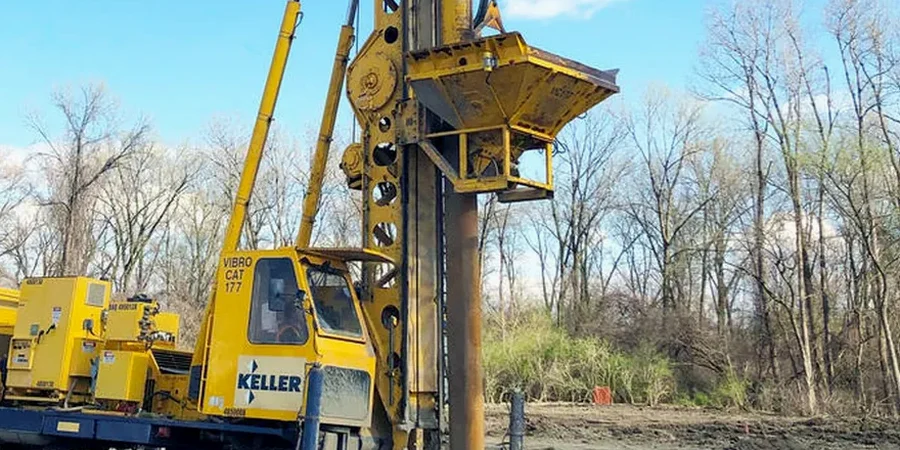
Fontana sits on the deep alluvial fan of Lytle Creek, a depositional environment that left behind thick sequences of loose to medium-dense sands and silty sands. Water table typically floats between 15 and 30 feet below grade across much of the city—close enough to complicate standard compaction but deep enough for effective dry bottom-feed vibroflotation. The USGS shear-wave velocity profiles for this quadrant of San Bernardino County show Vs30 values between 250 and 400 m/s in untreated ground, which classifies as Site Class D per ASCE 7-22. That alone drives settlement and liquefaction concerns for any structural fill or shallow foundation. A correctly engineered vibrocompaction design targets relative density above 70 percent, verified through pre- and post-treatment SPT correlations following ASTM D1586. For sites where fines content exceeds 15 percent, we often recommend supplementing the investigation with a CPT test to map thin interbedded silts that can reduce treatment efficiency.
A well-calibrated vibrocompaction program in Fontana alluvium can shift a Site Class D profile to Site Class C, cutting foundation costs by 20 to 30 percent.
How we work
Soil conditions shift noticeably between the older neighborhoods near Sierra Avenue and the newer industrial corridors south of the I-10. North Fontana, closer to the mountain front, carries coarser cobble-rich deposits with matrix-supported gravels—these respond well to top-feed vibroflotation at 6- to 8-foot triangular spacings and often reach 80 percent relative density in a single pass. South Fontana, by contrast, sits on finer sands with intermittent clay lenses deposited by ancestral Santa Ana River overflow. Here, the vibrocompaction design must account for silt pockets that can trap pore pressure during vibration. We adjust parameters—typically reducing spacing to 5 feet and increasing dwell time at the bottom of each stage—to ensure the target density propagates across the full treatment depth. The design package always includes a grid layout, probe penetration logs, amperage curves, and compaction criteria tied directly to the geotechnical baseline report. Our laboratory verifies grain-size distribution per ASTM D2487 on samples from each major stratum so that the vibrator frequency and water flow rate match the actual soil gradation, not just an assumed curve.
Local geotechnical context
Fontana lies within the westernmost reach of the San Jacinto Fault Zone, with a 10% probability of a M6.7 or greater event in the next 50 years according to the Uniform California Earthquake Rupture Forecast. Loose saturated sands at depths shallower than 40 feet can trigger liquefaction-induced settlement of 4 to 8 inches if left untreated—enough to rupture slab-on-grade foundations and sever underground utilities. The 2019 Ridgecrest sequence, though centered 120 miles north, reminded Inland Empire engineers that basin-edge amplification effects are real and often underestimated. A vibrocompaction design that ignores microstratigraphy risks leaving untreated lenses that become preferential drainage paths, accelerating post-seismic consolidation. We cross-reference the design with liquefaction triggering analyses using SPT-based procedures from Youd and Idriss (2001) and CPT-based methods from Robertson and Wride (1998), ensuring the factor of safety against liquefaction exceeds 1.3 at every treated interval. For sites within the Alquist-Priolo special studies zone, the design report includes a peer-reviewed seismic hazard section.
Quick answers
What soil types in Fontana are suitable for vibrocompaction?
Vibrocompaction works best in granular soils with less than 12 to 15 percent fines passing the #200 sieve. Fontana\'s alluvial sands and silty sands generally fall within this range, though south Fontana sites sometimes have interbedded silts that require closer probe spacing or a hybrid approach with stone columns. We always run a grain-size analysis (ASTM D2487) on samples from the target depth before finalizing the design.
How long does a typical vibrocompaction design and execution take in Fontana?
The design phase, including feasibility review and a trial program if needed, typically takes three to five weeks. Field execution for a standard commercial lot (1 to 3 acres) with treatment depths of 25 to 35 feet usually runs two to three weeks, plus another week for post-treatment verification testing. Permitting through the City of Fontana Building and Safety Department adds two to four weeks depending on plan-check backlog.
What does vibrocompaction design cost for a Fontana project?
Can vibrocompaction eliminate liquefaction risk in Fontana?
Yes, when designed correctly. By densifying loose sands to a relative density above 70 percent, the soil skeleton gains enough interparticle contact to resist pore-pressure buildup during seismic shaking. We confirm this through SPT and CPT correlations that show a factor of safety against liquefaction exceeding 1.3 across the full treatment depth. Sites with continuous clay layers may still experience some cyclic softening, which we address separately in the foundation design.