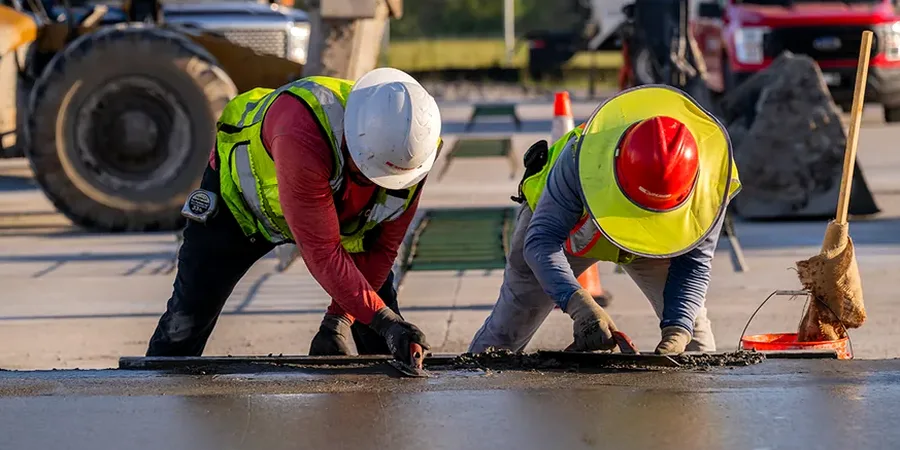
Fontana's jurisdictional codes reference ACPA and AASHTO 1993/98 pavement design methodologies, but what drives long-term slab performance here is the subgrade—granular alluvium with pockets of fine sand and occasional clay lenses from the Lytle Creek wash. A rigid pavement section designed without accounting for seasonal moisture variation in the upper 3 feet typically fails at joints and corners within the first five years. We integrate in-situ permeability testing with R-value determination to calibrate the modulus of subgrade reaction (k), then feed that into Westergaard edge-load and curling stress models. The result is a jointed plain concrete pavement (JPCP) thickness that matches actual field conditions, not just theoretical defaults. For industrial yards and truck lanes in the Sierra Avenue logistics corridor, we also verify that the concrete flexural strength meets the 650 psi modulus of rupture assumed in the ACPA StreetPave output. Complementing the subgrade assessment with a CBR road test helps validate the composite stiffness when a cement-treated base is under consideration.
A rigid pavement slab is a structural plate on an elastic foundation: get the k-value wrong by 50 pci and you're either 1.2 inches overdesigned or cracking at year three.
How we work
Fontana sits on the boundary between the Peninsular Ranges alluvial fans and the Santa Ana River basin, where subgrade soils range from poorly graded sands (SP) to low-plasticity silts (ML) within half a mile. This variability means two adjacent warehouse pads can require different slab thicknesses and joint spacings. Our design process starts with soil borings spaced no more than 300 feet on center, with laboratory classification per ASTM D2487 and R-value testing per California Test 301. We model load transfer efficiency at transverse contraction joints using ACPA's default 75% aggregate interlock for 15-foot joint spacing, but adjust downward to 55% when saw-cut timing exceeds 12 hours in hot weather. Key deliverables include panel size layout avoiding odd-shaped slabs under 2:1 aspect ratio, tie bar design for longitudinal construction joints, and dowel basket sizing for truck lanes exceeding 80 kip legal loads. The specification package references Caltrans Standard Specifications Section 40 for concrete mix design and Section 41 for joint sealing, ensuring the contractor has a clear, enforceable quality control framework.
Local geotechnical context
A 350,000-square-foot distribution center off Valley Boulevard poured its slab without a geotechnical investigation below the proposed grade line. The contractor used a 6-inch uniform thickness across the entire footprint. Within 18 months, the truck court exhibited step faulting at transverse joints exceeding 3/8 inch, and the dock approach slabs spalled at the saw-cut edges. Root cause analysis traced the failure to differential subgrade moisture: the eastern half of the site sat on silty sand with a k-value of 110 pci, while the western half had a cemented conglomerate layer at 2 feet depth producing a k-value above 400 pci. The fix required full-depth slab replacement in the failed panels with a variable-thickness design, dowel retrofitting in the remaining joints, and a positive subsurface drainage system. The repair cost exceeded the original slab budget. When we deliver a rigid pavement design in Fontana, the subgrade investigation is never optional: it dictates every structural parameter and prevents this exact scenario.
Quick answers
What concrete compressive strength is required for a rigid pavement in a Fontana industrial yard?
We typically specify a minimum 28-day compressive strength of 4,000 psi (per Caltrans Section 40) with a flexural strength of 570–650 psi. For heavy truck lanes, we raise the flexural requirement to 650 psi and verify it with third-point loading beam tests per ASTM C78.
How much does a rigid pavement design cost for a project in Fontana?
What joint spacing do you recommend for Fontana's temperature conditions?
Following ACPA guidelines, we design transverse joint spacing at 24 to 36 times the slab thickness, typically 12 to 15 feet for a 6- to 9-inch slab. Fontana's summer temperatures can exceed 105°F, so we apply a higher curling stress factor and verify that the spacing-to-radius-of-relative-stiffness ratio stays below 8 to avoid mid-panel cracking.
Do you provide construction-phase testing and inspection?
Yes. We perform fresh concrete testing (slump, air content, temperature), cast flexural beams, verify dowel alignment with MIT Scan-2 or manual methods, and check saw-cut timing and depth. This ensures the as-built pavement matches the design assumptions.