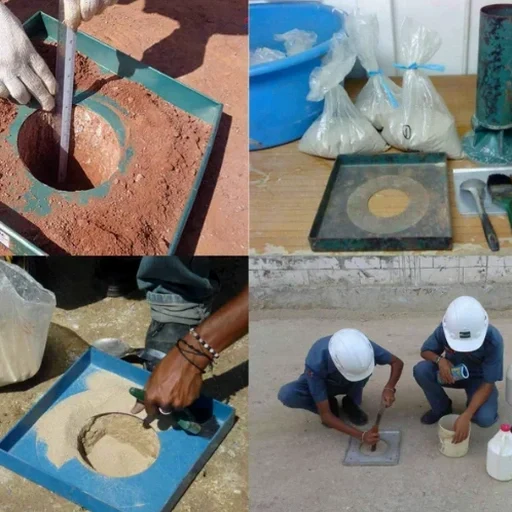
A warehouse expansion off Slover Avenue kept failing its final compaction check. The lab results were fine, but the proof roll told a different story. We mobilized a two-person crew to the site and ran a series of sand cone density tests directly on the building pad. Turns out the contractor had been over-compacting a silty sand mix, creating a crust that masked loose material underneath. Our field density measurements caught it before the slab was poured. That is the difference between a lab curve and what actually happens under a compactor in Fontana’s decomposed granite soils. When project schedules are tight and the Inland Empire sun is baking the subgrade, you need a density testing crew that shows up on time and knows how to read the ground. We run ASTM D1556 sand cone tests because the method is straightforward, repeatable, and does not rely on nuclear gauges that require special licensing and constant calibration. For roadway subbase along Sierra Avenue or utility backfill around storm drains, we often pair the sand cone with a Proctor test to establish the reference curve before field verification begins.
A sand cone test measures the actual density of soil in place, not a model or an inference. When a nuclear gauge gives ambiguous readings in Fontana’s decomposed granite, the sand cone settles the argument.
Local geotechnical context
Fontana sits at roughly 1,200 feet elevation where the alluvial fans from the San Gabriel Mountains spread across the valley floor, and the soil profile can shift from clean sand to silty clay within a hundred feet. The 2008 Chino Hills earthquake, a magnitude 5.4 event, reminded everyone that seismic shaking amplifies in loose fill and poorly compacted alluvium. A density test that passes at 90 percent modified Proctor might still leave a fill mass vulnerable to settlement under dynamic loads. We have seen trenches across the Fontana Redevelopment Corridor that looked solid during backfill but densified unevenly after the first wet winter because the moisture conditioning was off by two percent. Field density testing with the sand cone catches those problems before they become change orders. The method does not rely on a nuclear source, so there is zero radiation paperwork, and the equipment is simple enough to calibrate daily with a volumetric measure.
Standards that apply
ASTM D1556: Standard Test Method for Density of Soil in Place by the Sand-Cone Method, ASTM D698: Standard Test Methods for Laboratory Compaction Characteristics (Standard Proctor), ASTM D1557: Standard Test Methods for Laboratory Compaction Characteristics (Modified Proctor), AASHTO T-191: Density of Soil In-Place by the Sand-Cone Method, Caltrans Section 19: Earthwork, Field Density Testing requirements
Quick answers
How much does a sand cone density test cost in Fontana?
How long does a sand cone test take on site?
A single sand cone test takes about 20 to 30 minutes from setup to cleanup, including digging the hole, weighing the excavated soil, and running the moisture determination. If we are testing multiple locations across a site, we can typically complete four to six tests in a half-day visit depending on site access and soil conditions.
What compaction standard does Fontana require for building pads?
Most geotechnical reports in Fontana specify 90 to 95 percent relative compaction based on modified Proctor (ASTM D1557) for building pads and structural fill. The exact percentage depends on the soil type, proximity to the structure, and the engineer of record’s recommendation. Roadway subgrade often follows Caltrans Section 19 standards.
Can the sand cone method be used in coarse gravel or rock fill?
The sand cone method per ASTM D1556 works best in soils with particle sizes up to 1.5 inches. In gravels and cobbles, the test hole volume becomes too small relative to the particle size, and the results lose accuracy. For those conditions, we usually recommend a test pit with a rubber balloon density apparatus or large-scale water replacement method.
Why use the sand cone method instead of a nuclear density gauge?
The sand cone method gives a direct measurement of soil density and moisture content without relying on a nuclear source that requires licensing, radiation safety training, and frequent calibration against known density standards. In Fontana’s decomposed granite soils, which can have variable mineralogy that throws off nuclear gauge readings, the sand cone often provides the more defensible result when there is a dispute.